

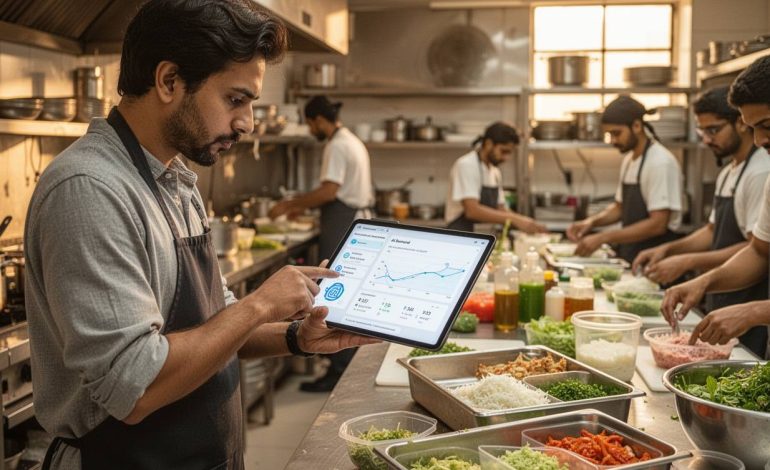
AI in Food Operations: Moving From Pilot Projects to Real Business Impact
The days of AI being a nice-to-have experiment in food operations are long gone. Today, forward-thinking players across India’s food and beverage industry are deploying artificial intelligence at scale, turning technology stack investments into measurable competitive advantages. From Mumbai cloud kitchens predicting evening rush patterns to Bangalore food processing plants autonomously rerouting shipments around traffic, AI is no longer a future promise but a present-day reality reshaping how food businesses operate, comply with regulations, and grow.
Why AI Matters Now: The Pressures Reshaping Food Operations
India’s food and beverage industry faces mounting pressure. The Institute of Food Technologists highlights AI’s shift from pilots to full deployment as the top trend for 2026, driven by resource scarcity, sustainability demands, and the rapid growth of urbanization. For restaurant consulting firms and food business experts, this shift represents both challenge and opportunity.
Consider the mathematics of waste. A Delhi-based cloud kitchen operator recently implemented AI-driven demand forecasting and watched his waste plummet by thousands monthly while scaling his virtual brands. This is not an isolated success story. The global AI in food and beverage market is projected to surpass US$179.8 billion by 2032, with automation slashing planning cycles by 30-50% for early adopters. In India, where cloud kitchen business models dominate urban delivery, these gains translate directly to resilience against monsoon delays, festival surges, and raw material volatility.
The Technology Stack: What Enterprise-Scale AI Actually Looks Like
Enterprise-scale AI in food operations is not a single tool; it is an integrated ecosystem. Modern food manufacturers and QSR operators now leverage cloud platforms that integrate data from manufacturing execution systems, IoT-enabled production lines, quality management tools, and ERP platforms into a single operational view. This convergence fundamentally changes how decisions get made on the factory floor.
The technology stack addresses three core operational areas. First, production planning and scheduling now run on predictive algorithms rather than spreadsheets. Second, automated quality checks catch defects before they reach customers, reducing food safety incidents by up to 40% in tested systems. Third, predictive maintenance of equipment prevents costly breakdowns that disrupt supply chains. A turnkey food factory consultant working with manufacturers across India sees this integration as non-negotiable for companies aiming for export compliance and premium partnerships.
Automating Supply Chains: The Self-Optimizing Network
Supply chain disruption has plagued Indian food businesses for decades. Monsoons delay shipments. Traffic snarls derail delivery windows. Supplier miscommunications create inventory mismatches. AI-powered systems are creating self-optimizing networks that predict and resolve these issues autonomously. Picture a Bangalore food processing plant where sensors track ingredients from farm to factory, automatically rerouting shipments around traffic congestion without a single missed delivery beat. This level of operational sophistication is now achievable, and increasingly affordable.
food processing consultants across India report that integrating real-time data orchestration across fragmented suppliers yields hyper-local efficiency gains. FICCI data shows Indian manufacturers achieving 25% better inventory utilization through such technology integration, vital for food processing consultancy services aiming at export compliance and cost optimization. The result is a network where human decision-makers focus on strategy while AI handles the predictive heavy lifting.
Food Safety and Compliance: AI as Your Regulatory Partner
FSSAI regulations demand rigorous food safety standards, and manual monitoring simply cannot keep pace with modern production volumes. AI monitors temperatures in real-time, detects contaminants via image recognition, and traces batches via blockchain integration. For sustainable food brands and cloud kitchen business operators, this means fewer recalls, unwavering customer trust, and the credibility needed to command premium positioning.
Compliance is shifting from manual checks toward digital-first systems. A food factory design consultant working with manufacturers notes that AI and process-mining tools enable companies to stay audit-ready, adapt quickly to regulatory changes, and reduce dependence on paper-based processes. For food business consultants advising operators, this transition from paper to pixels represents a fundamental de-risking of operations.
Real-World Wins: Stories From the Ground
Theory is useful. Results matter more. Reza, a Mumbai entrepreneur, partnered with food business experts to deploy AI in his operations. Automation handled portioning and packaging, dropping labor costs by 25% while his team shifted focus toward menu innovation. This is not about replacing people; it is about freeing skilled workers from repetitive tasks so they can contribute to food business growth and creative development.
A food consultant services firm working with QSR chains recently deployed robotic prep stations that integrate seamlessly with existing workflows, automating repetitive tasks while upholding food safety standards. Menu personalization engines now tailor offerings to local preferences, lifting order values and customer loyalty. Bakery consultants are weaving AI into dough mixing for precision that human hands struggle to achieve consistently. food and beverages consultants report that beverage lines optimized through AI achieve peak efficiency levels previously thought impossible.
From Demand Forecasting to Intelligent Ordering
AI-based ordering systems represent a seismic shift in how the food and beverage industry manages inventory. Guess-based ordering, with its inevitable overstock and stockouts, is giving way to intelligent demand forecasting that accounts for weather patterns, local events, seasonal trends, and even social media sentiment. Food manufacturers, traders, and distributors investing in integrated AI architectures now see 30-50% reduction in planning cycle times and a step-change in resilience.
This transformation matters especially for cloud kitchen operators managing multiple virtual brands with overlapping ingredient needs. food processing plant consultancy services now advise clients that the future of competitive advantage lies not in bigger warehouses but in smarter prediction algorithms. qsr consultants report that chains implementing these systems reduce waste while improving menu availability, a combination that directly improves customer satisfaction and margins.
Practical Steps: How to Move From Concept to Implementation
Ready to harness AI in your food operations? Here are actionable steps tailored for Indian food industry stakeholders:
- Begin with predictive analytics tools to forecast demand and trim waste by 15-20%. Platforms like EIT Food offer accessible entry points, ideal for food technology adoption whether you operate a cloud kitchen business or manage a food processing facility.
- Deploy robotic prep stations or automated quality checkpoints via qsr consultants, integrating seamlessly with existing workflows. Start with one high-volume task, measure results, then expand based on proven ROI rather than attempting a complete operational overhaul overnight.
- Adopt AI personalization engines with food product development consultants to tailor menus and pricing dynamically. This technology creates competitive differentiation while building customer loyalty, particularly valuable in crowded delivery app environments.
Beyond these foundational steps, partner with a food factory consultant or restaurant setup consultants who understand both your specific challenges and the broader food industry trends shaping your competitive landscape. The technology is one element; implementation strategy and change management are equally critical.
The Role of Expert Guidance in Scaling AI
As artificial intelligence and food technology evolve, pairing technology investments with expert guidance ensures scalability and reduces implementation risk. A cafe consultant can audit your current operations, identify high-impact automation opportunities, and pilot AI-driven solutions like dynamic pricing or waste-to-energy systems before full rollout. Food consultants specializing in sustainability help integrate carbon-tracking into every decision, positioning your brand as a sustainable food brand aligned with consumer values.
The food technology landscape is crowded with vendors, each claiming transformative potential. Restaurant consulting firms that understand both technology and food operations serve as essential guides, helping you distinguish hype from genuine capability. A food processing plant consultancy service with AI expertise can map your specific supply chain complexities and recommend architectures that deliver real efficiency gains rather than theoretical improvements.
Frequently Asked Questions (FAQs)
Does AI improve compliance with FSSAI food safety norms?
Absolutely. AI provides real-time monitoring and predictive alerts that exceed manual checks, ensuring complete traceability and slashing violation risks. For sustainable food brands and cloud kitchen business operators, this builds credibility and opens doors to premium partnerships with restaurants, hotels, and institutional buyers who demand proven compliance track records. Many operators report that AI-backed compliance systems actually reduce audit time while improving inspection scores.
How quickly can a small restaurant operator see ROI from AI investments?
Timeline depends on scope, but many operators see measurable gains within 3-6 months. A restaurant setup consultant will help you prioritize high-impact automation-demand forecasting typically delivers faster ROI than full kitchen automation. Start with a narrowly-defined problem, measure the impact precisely, then expand. Early adopters in India’s cloud kitchen space report payback periods of 6-12 months for demand forecasting systems, with waste reduction being the primary driver.
What is the typical cost of implementing AI in a mid-sized food processing operation?
Implementation cost varies widely based on complexity and existing technology infrastructure. A food processing plant consultancy service typically charges 8-15 lakhs for a foundational AI setup covering demand forecasting and quality monitoring, with larger ERP integrations running higher. However, the 25% inventory utilization improvement and 30-50% planning cycle reduction documented across Indian manufacturers typically justify the investment within the first year of operation.
Can food technology work for home-based kitchens or only large operations?
The narrative has shifted dramatically. Food-tech platforms increasingly use software-led models to formalize household-level production, bridging the gap between culinary skill and customer discovery. Technology now decouples skill from scale, allowing home kitchens to function as viable micro-enterprises. This represents a structural shift in India’s food economy, with platforms enabling home chefs to manage orders, working hours, and growth trajectory through intelligent backend systems.
Building Your AI-Ready Future
The question is no longer whether to invest in AI for food operations, but how quickly you can implement it strategically. The competitive gap between AI-enabled operators and traditional businesses is widening visibly. Early movers in India’s food and beverage industry are not just surviving volatility; they are thriving through it. They waste less, comply more consistently, delight customers more predictably, and scale without proportional headcount increases.
Your path forward requires clear-eyed assessment of your current challenges, honest evaluation of your organization’s readiness for change, and partnership with guides who understand both technology and food business realities. The technology stack exists. The expertise exists. The question is whether you will lead this transition in your segment or respond to competitors who move faster.
Ready to move from AI experiments to enterprise-scale advantage? Connect with food business experts and technology partners who understand India’s unique food industry landscape. Organizations like Tech4Serve bridge the gap between innovation and execution, helping food and beverage industry leaders navigate digital transformation with confidence. Your competitive future depends on decisions you make today.


